Supervised Domain Adaptation for Surface Defect Detection Leveraging Partial Data Availability
August 28, 2024· ,,,·
0 min read
,,,·
0 min read
Imanuel Heider
Jan Baumgärtner
Patrick Bartz
Alexander Puchta
Jürgen Fleischer
Abstract
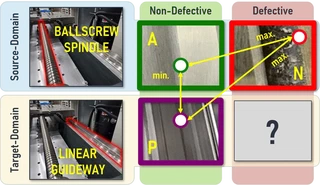
Defect detection in manufacturing applications using Deep Learning (DL) faces industry-specific challenges. The general scarcity of data is characteristic of the manufacturing sector. Therefore, the use of transfer learning approaches based on pre-existing data sets is a logical choice. The situation is particularly challenging when seeking to train a model for use in a new target domain. While target domain data from a non-defective class can in many cases be retrieved from the outset, data pertaining to defective classes only becomes accessible over time as defects naturally occur. Domain Adaptation (DA) approaches are suitable to address this issue, but they have limitations. Based on this starting point, this paper presents a novel approach that allows a model to be trained under these specific circumstances. The paper presents a combined solution consisting of a modified triplet loss function and a two-stage training process.
Type
Publication
In 2024 IEEE 20th International Conference on Automation Science and Engineering (CASE), pp. 4134-4139

Authors
Head of Research Industrial Robotics & Scientific Coordinator of CRC 1574
Hi I am Jan! I am a researcher working at the intersection of robotics and manufacturing. My work focuses on intelligent robotic manufacturing systems, where reconfigurable hardware and autonomous reasoning systems meet to enable autonomous and circular production. I also coordinate the Industrial Robotics research at wbk Institute of Production Science, KIT, as well as the Collaborative Research Centre 1574 Circular Factory for the Perpetual Innovative Product.