Milling using two mechatronically coupled robots
November 27, 2024· ,,,,·
0 min read
,,,,·
0 min read
Max Goebels
Jan Baumgärtner
Tobias Fuchs
Edgar Mühlbeier
Alexander Puchta
Jürgen Fleischer
Abstract
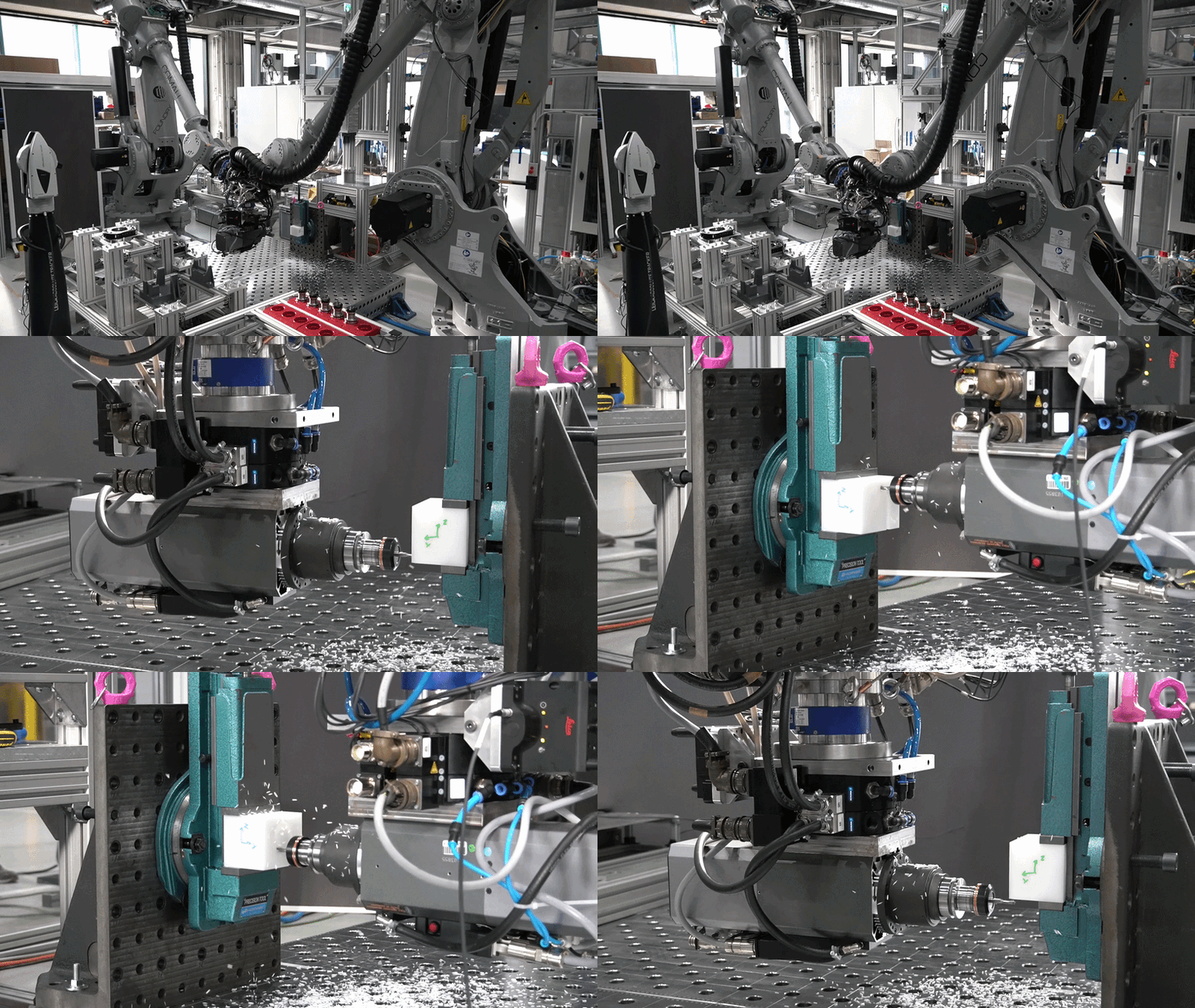
Industrial robots are commonly used in various industries due to their flexibility. However, their adoption for machining tasks is minimal because of the low dynamic stiffness characteristic of serial kinematic chains. To overcome this problem, we propose coupling two industrial robots at the flanges to form a parallel kinematic machining system. Although parallel kinematic chains are inherently stiffer, one possible disadvantage of the proposed system is that it is heavily overactuated. We perform a modal analysis to show that this may be an advantage, as the redundant degrees of freedom can be used to shift the natural frequencies by applying tension to the coupling module. To demonstrate the validity of our approach, we perform a milling experiment using our coupled system. An external measurement system is used to show that tensioning the coupling module causes a deformation of the system. We further show that this deformation is static over the tool path and can be compensated for.
Type
Publication
Procedia CIRP

Authors
Head of Research Industrial Robotics & Scientific Coordinator of CRC 1574
Hi I am Jan! I am a researcher working at the intersection of robotics and manufacturing. My work focuses on intelligent robotic manufacturing systems, where reconfigurable hardware and autonomous reasoning systems meet to enable autonomous and circular production. I also coordinate the Industrial Robotics research at wbk Institute of Production Science, KIT, as well as the Collaborative Research Centre 1574 Circular Factory for the Perpetual Innovative Product.